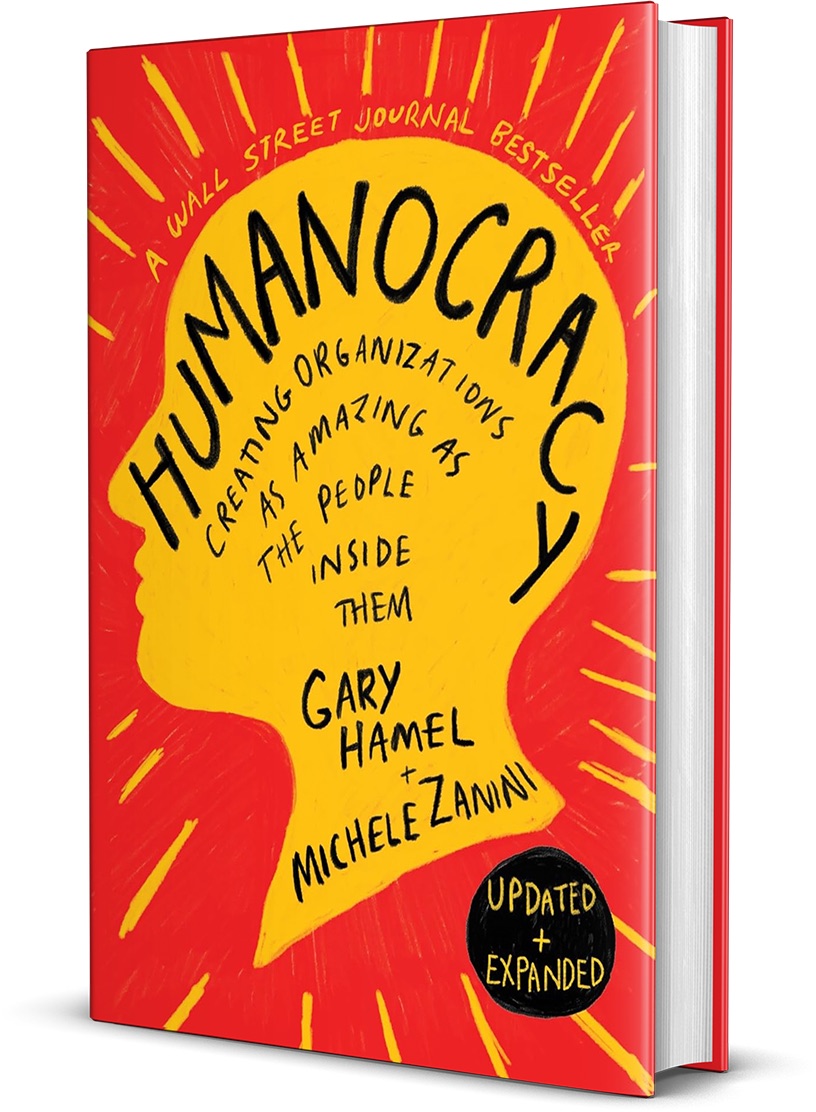
Humanocracy
Creating organizations as amazing as the people inside them.
Membangun organisasi yang sehebat manusia di dalamnya.
A practical manifesto by Gary Hamel & Michele Zanini for replacing bureaucracy with ownership, entrepreneurship, openness, experimentation, and distributed leadership.
Manifesto sekaligus panduan praktis Gary Hamel & Michele Zanini untuk mengganti birokrasi dengan ownership, entrepreneurship, openness, experimentation, dan leadership yang tersebar.
People are adaptable. Organizations often aren't.
Manusianya adaptif. Organisasinya sering tidak.
Outside work, people start businesses, raise families, organize communities, learn new skills, solve emergencies, and make complex decisions every day.
Di luar kantor, manusia membangun bisnis, membesarkan keluarga, mengelola komunitas, mempelajari kemampuan baru, menghadapi situasi darurat, dan membuat keputusan kompleks setiap hari.
✓ The problem is often not a lack of talent. It is a management system that underuses talent.
✓ Masalahnya sering bukan kekurangan talenta. Masalahnya adalah sistem manajemen yang tidak memakai potensi manusia secara penuh.
Outside work
Di luar kantor
Trusted to run a household, lead a team sport, manage money, handle a crisis.
Dipercaya mengelola rumah tangga, memimpin tim olahraga, mengatur uang, menghadapi krisis.
Inside the org
Di dalam organisasi
Treated as if they need layers of permission, supervision, rules, and approvals.
Diperlakukan seolah tidak bisa bergerak tanpa izin, supervisi, aturan, dan approval berlapis.
Bureaucracy was built for control, consistency, and scale.
Birokrasi dibangun untuk kontrol, konsistensi, dan skala.
- Stable markets
- Pasar relatif stabil
- Predictable demand
- Demand lebih dapat diprediksi
- Information concentrated at the top
- Informasi terkonsentrasi di atas
- Repetitive work
- Pekerjaan repetitif
- Efficiency as dominant advantage
- Efisiensi jadi keunggulan utama
- Discontinuous change
- Perubahan terus-menerus
- Complex customers
- Kebutuhan customer kompleks
- Information everywhere
- Informasi tersebar
- Knowledge work
- Knowledge work
- Innovation & adaptability matter
- Inovasi & adaptasi menentukan
"A system optimized for obedience struggles in a world that rewards initiative."
"Sistem yang dioptimalkan untuk kepatuhan akan kesulitan di dunia yang menghargai inisiatif."
Bureaucracy is not just annoying. It is expensive.
Birokrasi bukan sekadar menyebalkan. Biayanya mahal.
/ year — estimated cost of excess bureaucracy to the U.S. economy (Hamel & Zanini, HBR).
/ tahun — estimasi biaya kelebihan birokrasi bagi ekonomi AS (Hamel & Zanini, HBR).
Across 32 OECD economies, in their estimate.
Di seluruh 32 negara OECD, menurut estimasi mereka.
Meetings, reports, approval loops.
Meeting, laporan, dan approval loop.
Decisions move upward before action moves forward.
Keputusan harus naik dulu sebelum aksi bisa maju.
Ideas die before reaching customers.
Ide mati sebelum sampai ke customer.
People learn initiative is risky, obedience is safer.
Orang belajar berinisiatif berisiko, patuh terasa lebih aman.
Estimates are arguments from the authors' research, not universal accounting facts.
Estimasi ini adalah argumen dari riset penulis, bukan fakta akuntansi universal.
Stop treating people as instruments of the institution.
Berhenti memperlakukan manusia sebagai alat organisasi.
"How do we get people to better serve the organization?"
"Bagaimana membuat manusia melayani organisasi dengan lebih baik?"
"What kind of organization brings out the best people can give?"
"Organisasi seperti apa yang bisa memunculkan kontribusi terbaik manusia?"
The organization becomes the instrument; humans are no longer the instrument.
Organisasi menjadi alat bagi manusia untuk menghasilkan dampak — bukan sebaliknya.
Nucor — Everyone thinks like an owner.Semua orang berpikir seperti owner.
Nucor became one of the most admired steelmakers by running a surprisingly lean, decentralized management model.
Nucor menjadi salah satu produsen baja paling dikagumi lewat model manajemen yang lean dan terdesentralisasi.
Plants operate with substantial autonomy.
Pabrik memiliki otonomi besar.
Less distance between frontline work and decisions.
Jarak antara frontline dan keputusan dipangkas.
Teams directly feel the consequence of performance.
Tim merasakan langsung konsekuensi performa.
Operators are expected to solve problems too.
Operator juga diharapkan menyelesaikan masalah.
Ownership is behavioral before it is financial: people need room to decide, act, learn, and benefit from better performance.
Ownership itu perilaku sebelum menjadi finansial: orang butuh ruang untuk memutuskan, bertindak, belajar, dan merasakan manfaat dari performa yang lebih baik.
Haier — Entrepreneurship at scale.Entrepreneurship dalam skala besar.
Haier challenged the assumption that a huge corporation needs a huge hierarchy.
Haier menantang asumsi bahwa perusahaan besar selalu membutuhkan hierarki besar.
- ~56,000 employees, ~4,000 microenterprises
- ~56.000 karyawan, ~4.000 microenterprise
- Only a few layers to the CEO
- Hanya sedikit lapisan menuju CEO
- Teams organized around customer value
- Unit dibentuk dekat dengan value customer
- Internal services compete for users
- Internal service bersaing mendapatkan pengguna
Reduce the distance between employee and customer.
Kurangi jarak antara orang yang bekerja dan customer yang menerima value.
Seven principles for a post-bureaucratic organization
Tujuh prinsip organisasi post-bureaucratic
Ownership
Markets
Meritocracy
Community
Openness
ExperimentationExperimentation
Paradox
These are not "best practices" to copy mechanically. They are design principles that reshape structures, processes, incentives, and everyday behavior.
Ini bukan "best practice" untuk disalin mentah-mentah. Ini prinsip desain untuk membentuk ulang struktur, proses, insentif, dan perilaku sehari-hari.
Give people something real to own.
Beri orang sesuatu yang benar-benar bisa mereka miliki.
Authority to make meaningful decisions.
Wewenang membuat keputusan yang bermakna.
Clear responsibility for results.
Tanggung jawab terhadap hasil yang jelas.
A visible connection between contribution and benefit.
Hubungan nyata antara kontribusi dan manfaat.
"You own the result, but every decision still needs approval."
"Kamu bertanggung jawab atas hasilnya, tapi semua keputusan tetap harus minta izin."
Instead of "Build feature X by September" → try "Reduce onboarding drop-off from 48% to 30%. You choose the solution."
Daripada "Bangun fitur X sebelum September" → coba "Turunkan drop-off onboarding dari 48% ke 30%. Kamu yang pilih solusinya."
Ownership = freedom inside a clear responsibility boundary.
Ownership = kebebasan di dalam batas tanggung jawab yang jelas.
Let resources flow toward value, not hierarchy.
Biarkan resource mengalir ke value, bukan ke jabatan.
- Internal teams choose service providers
- Tim internal bisa memilih layanan yang paling memberi value
- Projects compete for talent
- Project bersaing sehat mendapatkan talent
- Experiments earn more funding as evidence improves
- Experiment dapat tambahan resource setelah bukti menguat
- Customers/users influence resource flows
- Kebutuhan customer memengaruhi alokasi resource
Markets do not mean "turn every colleague into a vendor." The principle is about creating stronger feedback between value and resource allocation.
Markets bukan berarti "ubah setiap kolega jadi vendor." Prinsipnya adalah membangun feedback yang lebih kuat antara value dan alokasi resource.
Influence should follow competence, not title.
Pengaruh seharusnya mengikuti kompetensi, bukan title.
"I am senior, therefore my idea wins."
"Saya lebih senior, jadi ide saya yang menang."
"The strongest evidence and relevant expertise should win."
"Evidence dan expertise yang paling relevan harus menang."
- Transparent peer feedback
- Peer feedback yang transparan
- Reputation built through contribution
- Reputasi dibangun lewat kontribusi
- Decision authority matched to expertise
- Wewenang keputusan mengikuti expertise
- Leaders persuade rather than command
- Leader meyakinkan, bukan memerintah
Meritocracy does not remove leadership. It changes the source of legitimate influence.
Meritocracy tidak menghapus leadership. Ia mengubah sumber pengaruh yang sah.
People give more to a mission than to a machine.
Orang memberi lebih banyak untuk sebuah misi daripada untuk sebuah mesin.
Why are we here?
Kenapa kita ada?
Do I feel part of "us"?
Apakah saya merasa jadi bagian "kita"?
Will colleagues help when things get hard?
Apakah rekan akan membantu saat situasi sulit?
Visible in decisions — not just posters?
Terlihat dalam keputusan — bukan cuma poster?
Culture is not what HR writes. Culture is what peers repeatedly reward, tolerate, and challenge.
Budaya bukan apa yang ditulis HR. Budaya adalah apa yang berulang kali dihargai, ditoleransi, dan digugat oleh rekan sekitar.
The organization should have more eyes, ears, and voices.
Organisasi perlu punya lebih banyak mata, telinga, dan suara.
People can access context needed to decide.
Orang punya konteks yang dibutuhkan untuk memutuskan.
Good ideas can come from anyone.
Ide bagus dapat datang dari siapa pun.
Insight can come from customers, partners, outside experts.
Insight bisa datang dari customer, partner, expert eksternal.
Anti-pattern: need-to-know culture + opaque decision making + executive-only context.
Anti-pattern: budaya need-to-know + keputusan buram + konteks hanya milik eksekutif.
"Default open unless there is a real reason to restrict."
"Default terbuka, kecuali ada alasan nyata untuk membatasi."
Evolution beats grand transformation plans.
Evolusi mengalahkan rencana transformasi raksasa.
- Make experiments cheap
- Buat experiment murah
- Decentralize permission
- Desentralisasi izin
- Shorten feedback loops
- Percepat feedback loop
- Reward learning, scale only after evidence
- Hargai pembelajaran, perbesar setelah ada bukti
- Pilot a new meeting rule for 30 days
- Pilot aturan meeting baru selama 30 hari
- One squad tries outcome-based planning
- Satu squad coba outcome-based planning
- One function removes an approval level
- Satu fungsi menghapus satu level approval
- Test peer-based funding for internal ideas
- Uji peer-based funding untuk ide internal
Do not redesign the whole company on PowerPoint. Hack one management process at a time.
Jangan mendesain ulang seluruh perusahaan di atas PowerPoint. Hack satu proses manajemen dalam satu waktu.
Great organizations can hold two opposing truths at once.
Organisasi hebat mampu memegang dua kebenaran yang tampak bertentangan.
Bureaucracy often resolves tension by choosing control. Humanocracy asks leaders to design systems where both sides coexist.
Birokrasi sering menyelesaikan ketegangan dengan memilih kontrol. Humanocracy meminta leader mendesain sistem di mana kedua sisi bisa hidup berdampingan.
"The job is not to eliminate tension; it is to make productive tension possible."
"Tugas kita bukan menghapus ketegangan, tetapi membuat ketegangan itu produktif."
Humanocracy changes how management actually works.
Humanocracy mengubah cara manajemen benar-benar bekerja.
| AreaArea | Who decides?Siapa yang memutuskan? |
|---|---|
| DirectionArah | Who sets priorities?Siapa menentukan prioritas? |
| GoalsGoals | Who defines outcomes?Siapa mendefinisikan outcome? |
| ResourcesResource | Who gets people and budget?Siapa dapat orang dan budget? |
| RolesPeran | How fluid are responsibilities?Seberapa cair tanggung jawab? |
| CoordinationKoordinasi | Hierarchy or direct collaboration?Hierarki atau kolaborasi langsung? |
| AreaArea | Who decides?Siapa yang memutuskan? |
|---|---|
| PerformancePerforma | Who evaluates whom?Siapa menilai siapa? |
| RewardsReward | What behavior earns recognition?Perilaku apa yang dihargai? |
| InnovationInovasi | Who is allowed to experiment?Siapa boleh bereksperimen? |
| TalentTalent | How can people move to opportunities?Bagaimana orang bisa pindah ke peluang? |
| RiskRisiko | Which decisions need central control?Keputusan mana yang butuh kontrol pusat? |
Culture follows systems more often than systems follow posters.
Budaya mengikuti sistem, jauh lebih sering daripada sistem mengikuti poster.
You don't need permission to redesign everything.
Tidak perlu menunggu izin untuk mendesain ulang semuanya.
This week: remove one unnecessary approval, open one previously closed source of context, or give one team a real outcome to own.
Minggu ini: hapus satu approval yang tidak perlu, buka satu sumber konteks yang tadinya tertutup, atau beri satu tim outcome nyata untuk dimiliki.
The goal is not fewer managers. It is more leaders.
Tujuannya bukan lebih sedikit manager. Tujuannya lebih banyak leader.
Humanocracy asks us to stop assuming that courage, judgment, creativity, and entrepreneurship belong only at the top. The organization's job is to create the conditions where those qualities can emerge everywhere.
Humanocracy meminta kita berhenti menganggap keberanian, judgement, kreativitas, dan entrepreneurship hanya milik orang-orang di puncak. Tugas organisasi adalah menciptakan kondisi agar kualitas itu bisa muncul di mana-mana.
"If every person in your organization behaved like an owner tomorrow, would your management system enable them — or stop them?"
"Jika besok semua orang di organisasi bertindak seperti owner, apakah sistem manajemen kita akan membantu mereka — atau justru menghentikan mereka?"
— A summary and interpretation of Humanocracy, Gary Hamel & Michele Zanini
— Ringkasan dan interpretasi Humanocracy, Gary Hamel & Michele Zanini